Blog

  • The NYC OER Soil Management Plan: Your Shield Against Disposal Violations

    The NYC OER Soil Management Plan: Your Shield Against Disposal Violations

    In New York City, dirt is never just dirt. If you’re developing a site with an E-Designation or a Restrictive Declaration, every yard of soil you move is a potential regulatory minefield. The "dirt police": a loose coordination between the NYC Office of Environmental Remediation (OER), the NYSDEC, and the DOB: are not looking for "good faith efforts." They are looking for documented compliance.

    If you treat your NYC OER Soil Management Plan (SMP) as a report to be filed and forgotten, you are inviting stop-work orders, $50,000+ fines, and catastrophic delays to your Certificate of Occupancy. At Envicon, we don’t sell you a PDF to sit on a shelf. We provide the operational roadmap that keeps your project moving and your site compliant.

    What is a Soil Management Plan (SMP)?

    An SMP is not a suggestion; it is a legally binding operational rulebook. When OER grants a Notice of Satisfaction or a Remedial Closure Report (RCR), it often comes with the requirement to manage residual contamination under an SMP.

    This document dictates exactly how soil must be screened, stockpiled, tested, and transported. It defines the "Engineering Controls": like vapor barriers or composite cover systems: that must remain intact for the life of the building. Failing to follow the SMP isn't just a technicality; it’s a breach of the recorded covenant on your property.

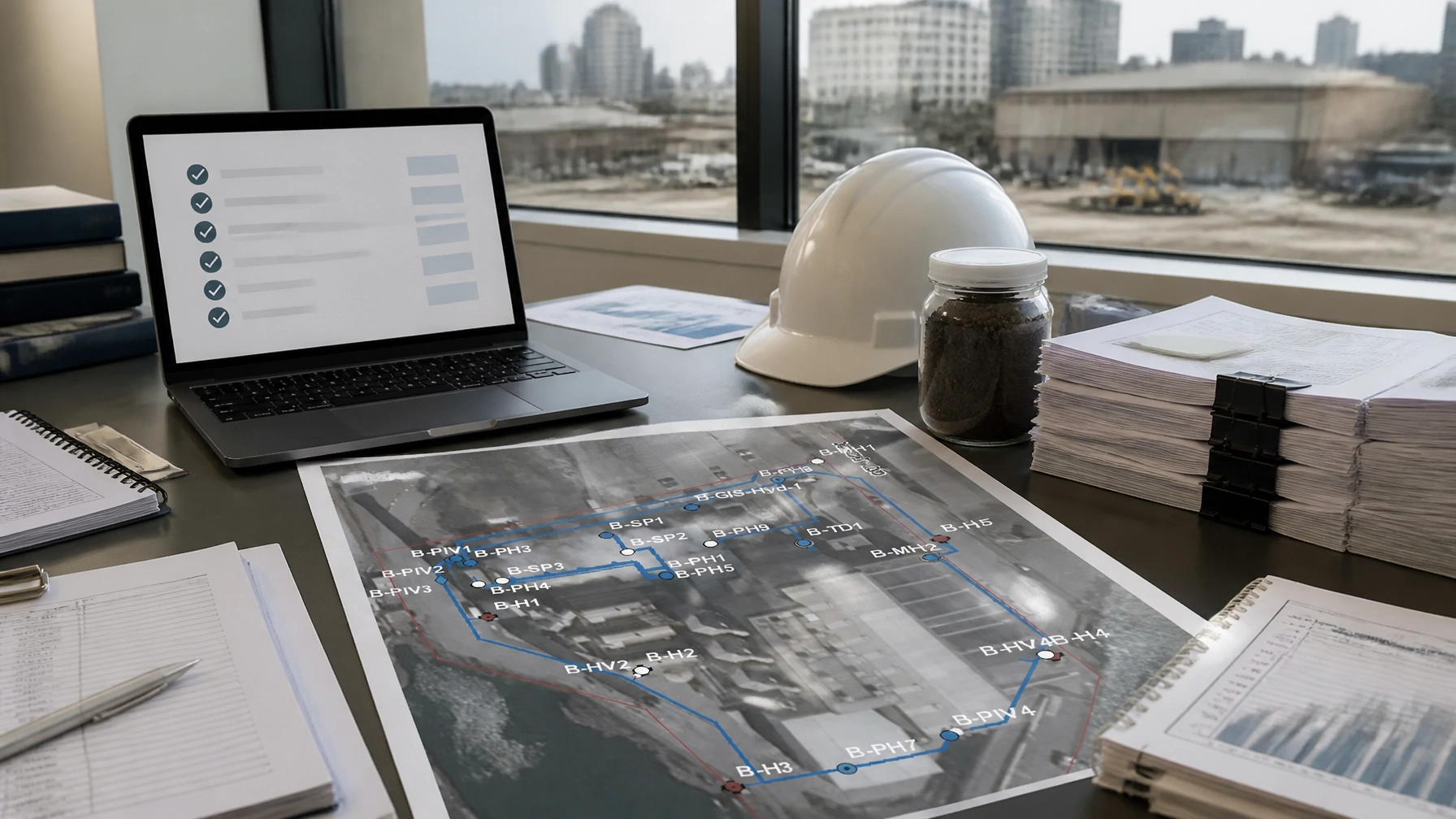
    Technical soil management compliance scene with truck manifests, disposal documentation, sample jars, and stockpile controls at an urban remediation site

    The NYC OER Soil Management Plan Compliance Checklist

    To stay ahead of the "dirt police," your site team needs a tactical checklist that translates the 50-page SMP into daily field actions. If your current consultant isn't giving you this level of specificity, you’re paying for a report that won’t protect you in the field.

    1. Pre-Excavation Prerequisites

    • Approval Status: Has the OER approved the Remedial Action Plan (RAP) and the specific SMP? You cannot break ground without a Notice to Proceed.
    • Waste Characterization: Have you performed "in-situ" sampling? Big-box firms often wait until soil is stockpiled, which doubles your handling costs. We sample while the dirt is still in the ground to get facility approvals before the first shovel hits.
    • Facility Acceptance: Do you have written approval letters from the receiving landfill or recycling center?

    2. On-Site Handling & Field Screening

    • Field Screening: A qualified environmental professional (QEP) must be on-site to screen soil with a Photoionization Detector (PID) and visual/olfactory checks.
    • Stockpile Management: Are stockpiles on poly-sheeting (20-mil minimum)? Are they covered at the end of the day?
    • Segregation: Never mix "clean" soil with "impacted" soil. One bucket of contaminated fill dumped into a clean pile can turn a $15/ton disposal into a $90/ton nightmare.

    3. Dust, Odor, and Vapor Control

    • Air Monitoring: Is your Community Air Monitoring Program (CAMP) active? Real-time particulate monitoring isn't just for OER; it’s your primary defense against neighbor complaints that trigger DOB inspections.
    • Suppression: Do you have a dedicated water source for dust suppression? In NYC, "we'll get a hose later" is a fast track to a violation.

    4. Transportation and Disposal Documentation

    • Licensed Haulers: Are your trucks carrying Part 364 permits?
    • Manifests: Every single load must have a non-hazardous or hazardous waste manifest.
    • Weight Tickets: You need a 1-to-1 match between your manifests and the facility weight tickets. Missing one ticket can stall an OER closure for months.

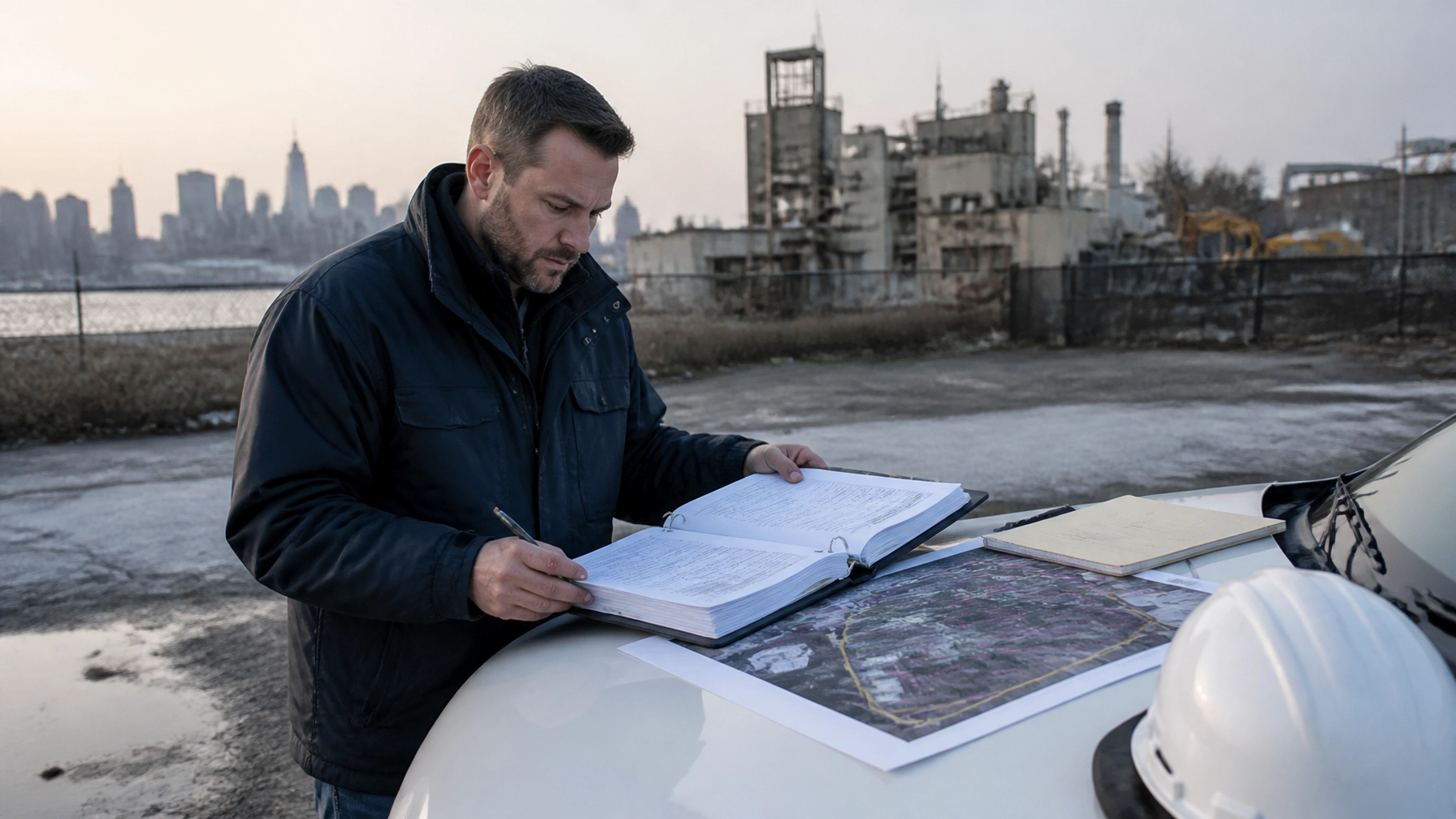
    Active remediation at an urban redevelopment site showing soil handling and environmental containment measures

    Avoiding the "Dirt Police" and Costly Violations

    The most common reason for an NYC project to stall at the 11th hour is "missing documentation." When you apply for your Certificate of Occupancy, OER reviews the Remedial Closure Report. If you can’t prove where 200 tons of soil went, or if your end-point samples weren’t taken at the correct frequency, OER will not sign off.

    The Envicon Difference: Large national firms treat this as a "clerical task" handled by junior staff. At Envicon, we treat documentation as a high-stakes engineering deliverable. We use real-time project reporting dashboards that track every manifest, every sample result, and every truck in real-time. You don’t have to wait for a monthly PDF to know if you're in compliance; you can see it on your phone at 7:00 AM.

    Dirt is Money: The Clean Soil Bank Opportunity

    Not all soil leaving an NYC site is "waste." The NYC Clean Soil Bank is a massive, underutilized resource that can save developers hundreds of thousands in disposal fees. If your soil meets the "Clean Fill" criteria (typically TAGM 4046 or unrestricted SCOs), it can be transferred to other NYC capital projects or public works.

    However, the window to qualify for the Clean Soil Bank is narrow. It requires early coordination with OER and rigorous testing protocols. Most "big-box" consultants won't bother with the paperwork because it’s easier for them to just tell you to ship it to a landfill in Pennsylvania. We look for the path that protects your budget, not the path of least resistance for the consultant.

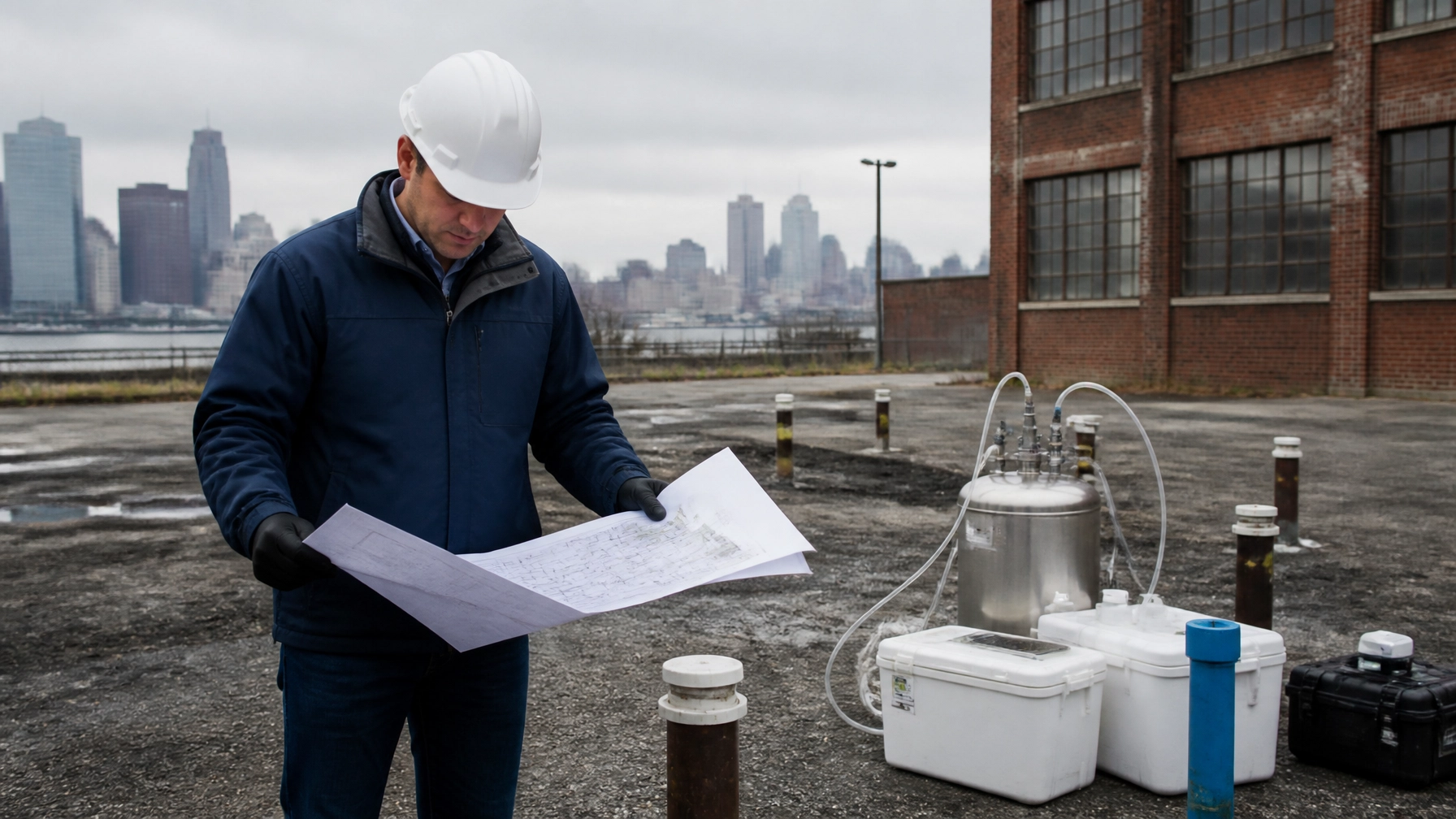
    Excavator performing soil investigations and site preparation at a remediation site

    Why Experience Matters in the 5-Boroughs

    NYC OER reviewers are specialists. They know the history of every block in Long Island City, the Bronx, and Brooklyn. If you submit a cookie-cutter SMP designed for a site in Ohio, they will flag it immediately.

    Envicon brings 20 years of direct agency relationships. We don’t sit in a queue; we sit at the table. We know what the reviewers expect because we work with them daily. When a field challenge arises: like hitting an abandoned UST that wasn't on the maps: we don't wait three days to "consult with the partner." We solve it on the spot, coordinate with OER, and keep the machines moving.

    Summary of Key Takeaways:

    • The SMP is Law: It is a legally binding document that stays with the property.
    • In-Situ Sampling is Essential: Characterizing soil before excavation saves time and money.
    • Documentation is the Product: Without manifests and weight tickets, you don't have a buildable site.
    • Technology Beats Paper: Real-time tracking prevents 11th-hour delays for your Certificate of Occupancy.

    Take Control of Your Site

    Stop paying for bloated reports that leave you vulnerable to field violations. You need a partner who understands that a "cleared path" is more valuable than a "defensive report."

    Whether you’re dealing with an active E-Designation or preparing for a Phase II Site Investigation, Envicon Group is built to move at the speed of New York development.

    Contact Envicon Group today to review your Soil Management Plan and ensure your project stays on schedule and under budget.

    Envicon Strategic Solutions logo - MAIN

  • The Data Advantage: Why Our Real-Time Dashboards Beat Your Consultant’s Monthly PDF

    Look, we’ve all been there. It’s the middle of the month, your lender is breathing down your neck for a status update on the remediation, and you’re staring at a PDF report that was sent three weeks ago. That report is a static snapshot of a site that doesn’t exist anymore. The soil has been moved, the groundwater has shifted, and your carrying costs are ticking up every hour you spend waiting for the "next update."

    In the high-stakes world of New York and New Jersey real estate development, relying on a monthly PDF is like trying to navigate the Holland Tunnel using a paper map from 1985. It’s slow, it’s outdated, and it’s defensive. Most national firms write those reports to protect themselves, not to move your project forward.

    At Envicon Group, we’ve ditched the "black box" consulting model. We believe that if you’re paying for the data, you should see the data, in real time. By leveraging advanced environmental project management technology, we’ve built a proprietary infrastructure that gives our clients real-time project reporting dashboards. This isn't just a shiny toy; it’s a fundamental shift in how remediation and civil engineering are executed.

    The "Monthly PDF" Trap: Why Your Consultant is Hiding Behind Paper

    When you hire a massive, national consulting firm, you’re usually paying for a partner to sell you the job and a junior staffer to actually do the work. The "Monthly Report" is their primary shield. It allows them to batch their errors, hide their delays, and present a curated version of reality that suits their internal billing cycle.

    Here’s what’s actually happening during that 30-day gap:

    • Data Lag: Field data collected on the 2nd of the month doesn't reach your inbox until the 30th. If a sample came back high, you’ve lost four weeks of reaction time.
    • Defensive Writing: Reports are often bloated with jargon designed to CYA (Cover Your Assets, well, their assets, actually).
    • The Communication Void: You don't know who is talking to the NJDEP or NYC OER reviewers, or what was actually said. You’re just told "it’s in progress."

    At Envicon, we don't sell reports. We sell cleared paths. That means giving you a direct line of sight into the field activity, the lab results, and the regulatory milestones as they happen.

    A 3D visualization of a subsurface groundwater plume model displayed on a sleek, industrial digital screen. The image shows technical data points, flow vectors, and contaminant concentration heat maps. The lighting is natural and professional, emphasizing precision engineering.

    Engineering with Live Data: How We Use Our Tech Stack

    Our real-time project reporting dashboards are more than just a list of tasks. They are integrated command centers for complex sites. Whether we are managing a Phase II Environmental Site Assessment or a multi-year remedial design, our tech stack changes the game.

    1. High-Frequency Monitoring & Telemetry

    For projects involving Vapor Intrusion (VI) or groundwater remediation, we don't just wait for quarterly lab results. We deploy field sensors equipped with real-time telemetry. If a sub-slab depressurization system (SSDS) loses pressure or a groundwater pump fails, our dashboard flags it instantly. We know before you do, and we’re likely already on-site fixing it before it becomes a regulatory violation or a safety hazard.

    2. Live Soil Management and Tracking

    On NYC sites under OER or DEC oversight, soil management is the biggest "surprise" cost. We use environmental project management technology to track every yard of soil from the bucket to the facility. Our clients can log in and see exactly how much "Historic Fill" has been exported versus "Clean Soil," providing an up-to-the-minute look at their disposal budget. This level of remediation project tracking and real-time reporting in New Jersey and New York prevents the $500k "disposal surprise" at the end of a project.

    3. Integrated GIS and Site Modeling

    We don't just hand you a 2D map. Our dashboards feature interactive GIS layers. You can toggle between soil boring locations, groundwater contours, and utility layouts. This spatial clarity is vital when coordinating with architects and structural engineers. It ensures that everyone is working off the same "single source of truth."

    Regional Fluency: Mapping NYC OER and NJDEP Milestones

    One of the biggest frustrations with "big-box" firms is that their project management software is built for generic offices, not for the specific hurdles of Hudson County or the Five Boroughs.

    Our systems are purpose-built for this market. We’ve integrated specific NYC environmental compliance project tracking modules that mirror the OER Voluntary Cleanup Program (VCP) milestones.

    • Notice to Proceed (NTP) Tracking: We track the lead-up to your NTP with granular detail, so you know exactly which reviewer has your Remedial Action Work Plan (RAWP) and what the outstanding comments are.
    • NJDEP LSRP Milestones: For our Jersey projects, our NJ environmental project management and reporting software tracks the mandatory timeframes for NJDEP LSRP submittals. You’ll never miss a biennial certification because your consultant "forgot" it was due.

    A high-tech environmental monitoring well cap with an integrated digital sensor. A glowing blue data stream radiates from the sensor, indicating a live connection to a cloud-based dashboard. The background is a crisp, professional construction site in New York.

    Avoiding the $500k "Surprise": The Business Impact of Speed

    Transparency isn't just a "feel-good" metric. It has a direct impact on your IRR. Every week of delay on a high-value development project incurs massive carrying costs.

    "Collaboration is not a buzzword: it's how we work. By opening up our data to the entire project team: developers, attorneys, and GCs: we remove the friction that usually stalls these projects." – Jason Pancoast, CEO.

    Think about a typical brownfield redevelopment environmental reporting dashboard in NY. If a localized spill is discovered during excavation, a traditional consultant might take a week to sample, two weeks for lab results, and another week to write the report. By that time, your excavator has demobilized and you're paying for idle equipment.

    With Envicon’s tech-enabled approach:

    1. Instant Capture: Our field engineer logs the discovery on a tablet.
    2. Rapid Lab Integration: We use labs with direct API links to our dashboard. Results pop up as soon as they are validated.
    3. Real-Time Review: Our PE reviews the data in the dashboard and updates the soil management plan within hours, not weeks.
    4. Action: The path is cleared before the next morning’s shift starts.

    Envicon vs. The "National" Firms: Why the Big Guys Can't Do This

    Large firms are built on billable hours and administrative layers. They have no incentive to show you their raw data because it would reveal the inefficiencies of their process. They want you to wait for the report because the report is the product.

    At Envicon, the outcome is the product. We are a family-owned, 20-year firm that is PE-led and field-first. We sit at the table with the regulators: OER, NYSDEC, NJ DEP: and we use our data to advocate for your project.

    Feature Large National Firm Envicon Group
    Data Visibility Monthly PDF (Static) Real-Time Dashboard (Live)
    Reporting Style Defensive & Bloated Clean, Action-Oriented & Technical
    Tech Stack Generic Office Software Custom-Built Env/Engineering Platform
    Communication Black Box Coordination Direct Access to Principals & Data
    Decision Speed Slow (Report-Based) Urgent (Data-Driven)

    Summary: Control Your Data, Control Your Project

    If your current consultant is treating your project like a secret, it’s time to ask why. In the modern regulatory environment of New York and New Jersey, you can’t afford to be in the dark.

    environmental consulting services with real-time dashboards in NJ and NY are no longer a luxury; they are a project requirement. By integrating environmental project management technology into every phase of our work, we ensure that your site is buildable, compliant, and moving forward.

    We don’t just deliver services; we help transform underused and contaminated properties into thriving assets. And we do it with the precision and speed that only a technology-first firm can provide.

    A sleek, professional tablet mounted on a modern tripod at a construction site overlooking the New Jersey skyline. The tablet screen displays a live, interactive GIS map with green 'on-track' status indicators and real-time sensor data overlays. Minimalist and authoritative.

    Ready to clear the path for your next project? At Envicon Group, we don’t just deliver reports: we deliver outcomes. Contact us today to discuss your site’s specific challenges.

    Envicon Strategic Solutions logo - MAIN

  • Living with the Past: NJDEP Historic Fill Material Remediation Requirements

    If you are developing in Jersey City, Newark, Paterson, or any of New Jersey’s legacy urban centers, you aren’t just building on soil: you are building on history. For over a century, New Jersey’s shoreline and wetlands were expanded using "historic fill": a heterogeneous mix of ash, cinders, brick, block, and dredging spoils.

    While this material once literally built the state, the New Jersey Department of Environmental Protection (NJDEP) views it as a "discharge." Under N.J.A.C. 7:26E (the "Tech Rules"), this means it must be remediated. However, for a developer, "remediation" doesn't necessarily mean "removal."

    Navigating NJDEP historic fill material remediation requirements is a balancing act between regulatory compliance and project pro-forma. If handled by a firm that treats your project like a cookie-cutter template, you’ll end up with a bloated sampling budget. If handled by a field-first firm like Envicon, you get a cleared path to a Response Action Outcome (RAO).

    What Qualifies as Historic Fill?

    The NJDEP defines historic fill as non-indigenous material, generally deposited before October 1976, used to raise the topographic elevation of a site. It typically contains large quantities of ash, coal, cinders, and construction debris.

    Crucially, historic fill is NOT process waste. If your "fill" contains chromate chemical production waste, ore processing slag, or hazardous industrial byproducts, the NJDEP reclassifies it as a separate Area of Concern (AOC). These do not get the same "presumptive remedy" benefits as historic fill and can trigger significantly more expensive excavation requirements. This is why the initial Preliminary Assessment and Site Investigation is the most critical phase of your project.

    The Strategy: To Sample or to Assume?

    When a Site Investigation (SI) confirms the presence of historic fill, developers face a strategic fork in the road under N.J.A.C. 7:26E-3.12.

    1. The "Assume Contamination" Path (The Pro Move)

    NJDEP rules allow you to bypass expensive analytical characterization of the fill itself. You can simply assume the material exceeds Residential Direct Contact Soil Remediation Standards (RDCSRS) and that groundwater is impacted.

    • Why do this? It saves thousands in lab fees and weeks of schedule. If you know the fill is staying on-site under a cap, why pay to prove it’s dirty? You move straight to delineating the extent of the fill rather than its chemistry.
    • The Catch: You must still investigate any specific AOCs (like former USTs or floor drains) within the fill footprint independently.

    2. The "Sample and Evaluate" Path

    If you believe your fill might actually meet residential standards: perhaps it’s mostly clean silty sand: you can sample it.

    • The Risk: If you sample and find even one exceedance of Polycyclic Aromatic Hydrocarbons (PAHs) or Lead (extremely common in NJ fill), you are back to square one, but with a lighter wallet.

    High-resolution inline technical image of a historical industrial site map overlaid with modern investigation grid points, boring locations, and remediation boundary annotations for an urban New Jersey brownfield parcel.

    The Presumptive Remedy: Engineering and Institutional Controls

    New Jersey law (specifically the Brownfield Act) provides a "rebuttable presumption" that you do not have to remove historic fill. Instead, the standard remediation is to leave it in place and "manage" it. This involves a three-pronged approach:

    1. Engineering Controls (The Cap)

    You must prevent humans from touching the contaminated fill. In an urban redevelopment, your project is often its own remedy.

    • Building Slabs: The footprint of your new building serves as a perfect cap.
    • Pavement: Asphalt or concrete parking lots and sidewalks are approved engineering controls.
    • Clean Fill/Landscaping: In "green" areas, NJDEP typically requires 12 to 24 inches of certified clean fill over an orange poly-marker "warning barrier" to prevent future utility workers from accidentally digging into the historic fill.

    2. Institutional Controls (The Deed Notice)

    Since you are leaving contamination on-site, the public must be notified. A Deed Notice is recorded with the County Clerk, describing the location of the fill and the requirements to maintain the cap. This stays with the property title forever (or until the fill is removed).

    3. Ground Water Classification Exception Area (CEA)

    Historic fill almost always impacts groundwater, usually with metals or PAHs. Instead of active pumping and treating, NJDEP allows for a CEA. This is a "paper" restriction that designates the groundwater under your site as non-potable for a specific duration. For historic fill, the CEA is typically set to the property boundary, making the process significantly simpler than a traditional chemical plume investigation.

    Why Your Choice of Consultant Matters

    At many national firms, historic fill is treated with a defensive, "check-the-box" mentality. They’ll send a junior staffer to the field, write a 400-page report that protects their liability more than your project, and then hand you a massive bill for "regulatory coordination."

    Envicon does it differently:

    • Direct LSRP Access: You don't talk to a project manager who talks to a Licensed Site Remediation Professional (LSRP). You talk to the person signing the forms. Our NJDEP LSRP Guide outlines how we cut through the bureaucracy.
    • Field-First Engineering: We look at your civil grading plans while designing the remediation. If we can use the existing site soils to balance the site under a cap, we save you six figures in disposal costs.
    • Regulatory Fluency: We know the reviewers at NJDEP by name. We don't guess what they want; we know their technical preferences, which prevents the dreaded "Notice of Intent to Deny" on your permit applications.

    A technical diagram-style visual of a remediation cap cross-section. It shows a modern building slab on top, followed by a layer of clean soil, an orange mesh warning barrier, and finally the historic fill material below. The image is clean, sharp, and uses professional engineering graphics.

    The Post-Remediation Reality: Permits and Monitoring

    Once the remedy is in place and your LSRP issues the RAO, the work isn't entirely over. You will need a Soil Remedial Action Permit (SRAP). This permit requires:

    1. Biennial Certifications: Every two years, a professional must inspect the cap (check for cracks in the pavement, holes in the lawn) and certify to the NJDEP that the remedy is still protective.
    2. Financial Assurance: For most private developers, the NJDEP requires a stand-by trust or letter of credit to ensure funds are available to maintain the cap in perpetuity.

    Managing these Compliance & Permit requirements is where most projects fail long-term. Envicon’s digital solutions provide real-time dashboards so you never miss a biennial filing or a permit renewal.

    Summary: Turning Legacy Land into Assets

    Historic fill doesn't have to be a project-killer. In fact, for many developers, it’s a predictable hurdle that can be managed with the right strategy.

    • Confirm early: Use a Preliminary Assessment to define if your fill is truly "historic" or if you have a more complex "waste" issue.
    • Assume and Delineate: Don't waste money sampling what you're going to cap anyway.
    • Integrate the Remedy: Make your building and parking lots do double-duty as your engineering controls.
    • Plan for the SRAP: Factor the long-term monitoring costs into your project pro-forma.

    "In NJ urban redevelopment, you aren't just managing soil; you're managing a regulatory timeline. If your consultant isn't thinking about the Remedial Action Permit during the first week of due diligence, they're already behind." : Envicon Engineering Team

    Your project is too high-stakes for a "big box" firm to treat as an afterthought. If you’re facing NJDEP historic fill material remediation requirements on your next build, let’s clear the path.

    Contact Envicon Group today to discuss your site strategy.


    Envicon Strategic Solutions logo - MAIN

  • Field Realities: Key Updates in the 2024 NJDEP Field Sampling Procedures Manual

    Field Realities: Key Updates in the 2024 NJDEP Field Sampling Procedures Manual

    For nearly two decades, the 2005 Field Sampling Procedures Manual (FSPM) was the bible for environmental consultants in New Jersey. If you were a developer or an attorney, you likely assumed your consultant knew it by heart. But as of early 2024, that bible has been rewritten.

    The NJDEP field sampling procedures manual 2024 updates represent more than just a technical refresh; they are a direct response to the "forever chemicals" (PFAS) crisis and a push for higher data integrity. For developers, these changes mean that the "old way" of sampling: the way your big-box firm’s junior staff might still be doing it: is a fast track to rejected submittals, expensive re-mobilizations, and project delays.

    At Envicon, we don't just read the manual; we live it. Here is the technical breakdown of what has actually changed and why it matters for your bottom line.

    The Death of Field Filtration: A PFAS Necessity

    The most significant shift in the 2024 FSPM involves how we handle groundwater. For years, consultants dealing with "cloudy" or turbid samples would simply filter them in the field to get a "clean" reading.

    Under the 2024 framework, field filtration is explicitly disallowed for PFAS.

    PFAS compounds have a nasty habit of adsorbing to filter membranes. If your consultant filters the sample, they aren't just removing sediment; they are likely removing the very contaminants they are supposed to be measuring. This results in false negatives that will eventually be caught by the NJDEP or a future buyer’s due diligence.

    The Business Impact

    If you have a site with high turbidity, you can no longer "filter your way to compliance." You need a team that understands how to achieve a turbidity of <10 NTU through superior well construction and advanced low-flow purging techniques. Anything else is just bad data that won't hold up under LSRP scrutiny.

    Envicon engineers overseeing site remediation activities in New Jersey

    Groundwater Sampling: Low-Flow is No Longer Optional

    Close-up of groundwater sampling equipment including bailers, low-flow pump tubing, flow-through cell, sample vials, calibration meter, and field notebook at a monitoring well

    While the 2005 manual allowed for various purging methods, the 2024 update makes low-flow or passive sampling the preferred default for PFAS and other sensitive parameters.

    The NJDEP has clarified that the "volume-average" sampling policy: the old method of pumping out three well volumes: does not apply when sampling for Contaminants of Emerging Concern (CEC) like PFAS.

    Why this matters for your schedule:

    1. Precision over Speed: Low-flow sampling takes longer per well than traditional purging. If your consultant hasn't updated their bid to reflect these 2024 realities, expect a "change order" midway through the project.
    2. No Exceptions for Bad Tech: The department expects methods that reduce turbidity at any time. If your consultant isn't bringing a properly calibrated flow-through cell and digital turbidity meter to the field, they aren't following the manual.

    Soil Sampling and the "Vertical Migration" Mandate

    The 2024 update places a much heavier emphasis on the conceptual site model (CSM), specifically regarding how PFAS leaches through the soil column.

    Previously, a "surface sample" might have sufficed for certain investigations. Now, the Fact Sheet (supplementing the FSPM) explicitly states that soil samples may need to be collected from multiple depth intervals to account for vertical migration to groundwater.

    At Envicon, we integrate this into our Site Investigation and Characterization process from day one. We don't just poke holes; we map the risk. For a developer, this means more upfront sampling, but it prevents the "missing data" trap that stalls NJDEP approvals for months.

    Technical PFAS-free sampling equipment and HDPE bottles

    The "PFAS-Free" Field Reality

    The 2024 manual formalizes the logistical nightmare of PFAS cross-contamination. It isn't just about the sample bottles; it's about everything on the site.

    • Sampling Sequence: Potable water samples must be collected first, and they must be physically segregated from soil, sludge, or non-potable water samples.
    • Equipment Decon: You can no longer use just any detergent. The SDS (Safety Data Sheet) for every soap used on-site must be reviewed to ensure it contains no fluorosurfactants.
    • The "Blue Pen" Rule: While not explicitly in the text, the industry standard enforced by the 2024 update means no Sharpies, no waterproof notebooks, and no specialized "outdoor" gear that might contain Teflon or Gore-Tex near the sampling point.

    When you hire a large national firm, a partner sells the project, but a junior staffer: who might not have been briefed on these 2024 nuances: is the one actually holding the bottle. At Envicon, our leadership is in the field, ensuring the "PFAS-free" protocol isn't just a line in a report, but a field reality.

    Full List Reporting: No More Hiding the Ball

    NJDEP now expects LSRPs and PRCRs (Persons Responsible for Conducting Remediation) to report the full list of PFAS compounds analyzed by the lab, not just the three regulated ones (PFOA, PFOS, PFNA).

    This is a massive shift in liability. If your lab runs a method that identifies 40 different PFAS compounds, you have to report all 40. Even if they aren't currently "hazardous substances" under NJ law, the NJDEP can require investigation if they believe those compounds pose a risk.

    This is where you need a consultant who acts as a Regulatory Compliance and Permitting expert. You need a strategy for what happens after the data comes back, not just a firm that drops a 500-page lab report on your desk and walks away.

    Active brownfield redevelopment site with heavy excavation equipment

    The Envicon Difference: Speed through Tech

    The 2024 FSPM updates require more documentation, more blanks (Field Reagent Blanks), and more meticulous field notes. Large firms handle this by increasing their billable hours and slowing down their turnaround.

    We do it differently. We’ve built proprietary project management infrastructure that gives our clients real-time dashboards. While a national firm is still transcribing field notes from a soggy notebook, our data is already being QA/QC'd and uploaded.

    We don't sell "compliance"; we sell a cleared path. In the world of NJDEP remediation, compliance is the baseline. The real value is getting to your Response Action Outcome (RAO) without the regulatory "ping-pong" caused by bad field data.

    Summary Checklist for Developers and Attorneys

    To ensure your project remains compliant with the 2024 NJDEP Field Sampling Procedures Manual, verify that your consultant is:

    • Defaulting to Low-Flow Sampling: If they are "slugging" wells with bailers, your data is at risk.
    • Using PFAS-Free Water: Are they documenting the source of their field blank water?
    • Eliminating Field Filtration: If they suggest filtering for PFAS, fire them.
    • Segregating Samples: Potable water and highly contaminated soil should never share a cooler.
    • Reporting Full Suites: Are they prepared for the liability of the full PFAS analyte list?

    Ready to Clear Your Path?

    Don't let 2005-era field practices stall your 2026 development. Whether you're navigating an NJDEP LSRP Guide requirement or a complex brownfield, you need field-first leadership.

    Stop paying for junior-staff mistakes. Contact Envicon Group today to ensure your field data is bulletproof.

    Envicon Strategic Solutions logo - MAIN

  • The Receptor Evaluation: Why This Form is the Foundation of Your NJ Remediation Schedule

    The Receptor Evaluation: Why This Form is the Foundation of Your NJ Remediation Schedule

    If you’re developing property in New Jersey, you’ve likely heard your LSRP mention the "Receptor Evaluation" (RE) form. To the uninitiated, it looks like just another piece of NJDEP paperwork. To an experienced developer or project manager, however, the RE form is the most critical document in the early phase of a project.

    It isn't just a compliance checkbox. The Receptor Evaluation is the primary tool NJDEP uses to determine the level of "threat" your site poses to the public and the environment. Missing a deadline or mishandling the data on this form doesn't just result in a fine; it can fundamentally shift your project from a standard cleanup into an Immediate Environmental Concern (IEC) status, which brings construction to a grinding halt.

    At Envicon, we don’t treat the RE as a standalone report. We treat it as the roadmap for your site investigation and remediation strategy.

    The One-Year Clock: NJDEP Receptor Evaluation Form Submission Deadlines

    The most important thing to know about the Receptor Evaluation is that it has a hard deadline. Under N.J.A.C. 7:26E-1.12(c), the initial Receptor Evaluation form is due no later than one year after the earliest "requirement to remediate."

    What triggers that one-year clock? It’s usually one of three things:

    1. The discovery of a discharge (e.g., a failed tank test or a contaminated soil sample).
    2. An ISRA-triggering event (like the sale of an industrial business).
    3. The issuance of a court order or NJDEP directive.

    If your consultant is sitting on your data and misses this window, you’re not just late: you’re out of compliance with a Regulatory Timeframe. In New Jersey’s LSRP program, missing regulatory timeframes puts you on the fast track to Direct Oversight, where the NJDEP takes the wheel, chooses your remedy, and potentially hits you with penalties of up to $20,000 per day.

    Detailed GIS-style surrounding land-use and receptor screening map with parcel boundaries, 2,000-foot well search radius, nearby buildings, and surface water features

    Why the RE is the Foundation of Your Schedule

    The Receptor Evaluation forces an LSRP to look beyond the property lines. It asks: Who or what is at risk? The answers to these questions dictate the scope and speed of your entire project.

    1. Potable Well Searches

    The RE requires a 2,000-foot well search. If your site has groundwater contamination and there are potable wells within that radius, you are no longer in a "monitor-and-wait" scenario. You are now looking at high-priority sampling and potential point-of-entry treatment systems (POETS).

    2. Vapor Intrusion (VI)

    If your site has volatile organic compounds (VOCs) and there are occupied buildings nearby, the RE triggers a Vapor Intrusion investigation. This can mean installing sub-slab depressurization systems in neighboring properties: a massive logistical and financial hurdle if not planned for in your initial remediation design.

    3. Ecological Receptors

    Is there a wetland or a stream adjacent to your site? The RE identifies these sensitive areas. If contaminants are migrating toward them, your "simple" soil cleanup just became an ecological risk assessment with significantly higher cleanup standards.

    By identifying these "receptors" early, we can build a remediation schedule that accounts for these variables. Big-box firms often wait until the last minute to fill out the RE form, only to "discover" a sensitive receptor that blows the budget and the timeline six months into the project. We do the work upfront so there are no surprises.

    Milestone Updates: SI, RI, and RA

    The Receptor Evaluation is not a "one-and-done" document. NJDEP requires that it be updated and resubmitted with every major milestone report:

    • Site Investigation (SI) Report
    • Remedial Investigation (RI) Report
    • Remedial Action (RA) Report

    Each update confirms that no new receptors have appeared (like a new daycare opening next door) and that your remediation is successfully protecting the receptors you already identified.

    Environmental technician collecting groundwater samples on a NJ brownfield site

    The Envicon Difference: Direct Leadership vs. The Black Box

    When you hire a national firm, the person filling out your RE form is likely a junior staffer in a satellite office who has never stepped foot on your site. They’re looking at a map and a database, checking boxes to protect their firm’s liability.

    At Envicon, we operate differently:

    • PE-Led Strategy: Your Receptor Evaluation is handled by the same professionals who sit at the table with the NJDEP. We understand the nuances of the "Receptor Evaluation FAQ" and how to navigate complex VI or well-search issues without over-complicating the project.
    • Real-Time Visibility: Most firms hand you a PDF report once a month. Through our digital solutions, our clients have real-time access to project dashboards. You’ll know exactly where we are with the RE well search and when the form is ready for submittal: no "black box" coordination.
    • Regulator Fluency: We know the reviewers at the NJDEP. We know what they’re looking for in an RE update, which means cleaner submittals and a faster path to your Response Action Outcome (RAO).

    Digital dashboard showing real-time remediation milestones and regulatory deadlines

    Summary: Don't Let a Form Stall Your Project

    The Receptor Evaluation is the "brain" of your New Jersey remediation project. It defines the risks, dictates the urgency, and sets the schedule.

    • Initial Deadline: 1 year from the "requirement to remediate."
    • Ongoing Updates: Required at SI, RI, and RA milestones.
    • Impact: Missing receptors leads to IECs and construction delays.
    • Risk: Missing deadlines leads to fines and NJDEP Direct Oversight.

    If your current consultant treats the RE form as an afterthought, you’re sitting on a ticking clock. You need a partner who sees the cleared path, not just the report.

    Take Ownership of Your Schedule

    Don't wait for a "deficiency letter" from the state. Let’s look at your site, identify your receptors, and build a schedule that keeps your project moving.

    Contact Envicon Group today to ensure your Receptor Evaluation and NJDEP filings are on track.


    Envicon Strategic Solutions logo - MAIN

  • Vapor Intrusion: What the 2021 NJDEP Remediation Standards Mean for Your Next Build

    Vapor Intrusion: What the 2021 NJDEP Remediation Standards Mean for Your Next Build

    If you’re developing in New Jersey, you already know the regulatory landscape is a moving target. But the update that hit in May 2021 wasn’t just a minor adjustment: it was a fundamental shift in how the state handles vapor intrusion (VI).

    What used to be "guidance" is now codified law. The NJDEP’s 2021 amendments to the Remediation Standards (N.J.A.C. 7:26D) converted vapor intrusion screening levels into enforceable remediation standards. For developers, attorneys, and LSRPs, this means the margin for error has disappeared. If you aren't hitting these numbers, you aren't in compliance: period.

    At Envicon, we don't just hand you a report and wish you luck. We navigate these technical shifts to ensure your project stays on schedule and under budget. Here is exactly what the 2021 standards mean for your next build and how to avoid the common pitfalls of the new regime.

    From Guidance to Law: Why This Shift Matters

    Historically, vapor intrusion was managed through the Vapor Intrusion Technical Guidance (VITG). It provided "screening levels" (VISLs) and "indoor air screening levels" (IASLs). While these were treated as the industry standard, they weren't technically codified regulations. They were benchmarks used to guide decision-making.

    That changed on May 17, 2021. The NJDEP formally adopted indoor air remediation standards for the vapor intrusion pathway.

    The immediate fallout:

    • Enforceability: Failing to meet an indoor air standard is now a direct regulatory violation, not just a recommendation for further study.
    • The Order of Magnitude Rule: While there was a six-month phase-in period, any new standard that is more stringent than the old guidance by an "order of magnitude" (a factor of 10) applied immediately.
    • Re-Opening Closed Cases: If a previously "closed" site has contaminants that now exceed the new standards by an order of magnitude, the NJDEP can technically re-open the case.

    If you’re working with a big-box firm that is still quoting the 2018 guidance values, you’re already behind. You need an LSRP who understands the NJDEP LSRP framework as it stands today, not as it was three years ago.

    The Numeric Reality: Compound Changes

    The 2021 update didn't just change the status of the numbers; it changed the numbers themselves. Some contaminants became harder to manage, while others saw their thresholds relaxed.

    For example, 1,1-dichloroethene (1,1-DCE) saw its indoor air standard revised for both residential and non-residential exposures. Across the board, the NJDEP updated toxicological data for dozens of compounds.

    • Stricter Standards: Four groundwater contaminants and six soil gas contaminants became more stringent or newly regulated.
    • Relaxed Standards: Twelve groundwater and twelve soil gas contaminants saw their screening levels increase (become less stringent).

    This isn't just trivia. If your Phase II Site Investigation was conducted under the old numbers, your "clean" site might now be a "contaminated" one. At Envicon, we use our real-time project dashboards to cross-reference your site data against the latest regulatory tables instantly. We don't wait for a monthly report to tell you there’s a problem.

    High-resolution vapor barrier installation with sealed seams and sampling point penetrations at a New Jersey redevelopment site

    The Sampling Trap: VITG 5.0 and Footprint Density

    Perhaps the most significant "hidden" cost of the new standards comes from the proposed updates to the Vapor Intrusion Technical Guidance (VITG 5.0). While the standards (the numbers) are law, the guidance (how you collect the data) is also evolving to match.

    For large footprints: think the massive industrial warehouses currently dominating the New Jersey landscape: the required density for sub-slab soil-gas (SSSG) sampling is skyrocketing.

    • Old Guidance: A 250,000 sq. ft. warehouse might have required 8 to 10 sub-slab samples.
    • New Proposed Guidance: That same building could now require over 150 samples to be considered compliant.

    This is where the "big firm" model fails you. They will simply bill you for 150 samples and the hundreds of man-hours required to collect them. At Envicon, we look for the "cleared path." We evaluate the Conceptual Site Model (CSM) to determine if we can use Alternative Remediation Standards (ARS) or site-specific data to reduce the need for exhaustive, "carpet-bomb" sampling.

    SSDS: Active vs. Passive Systems

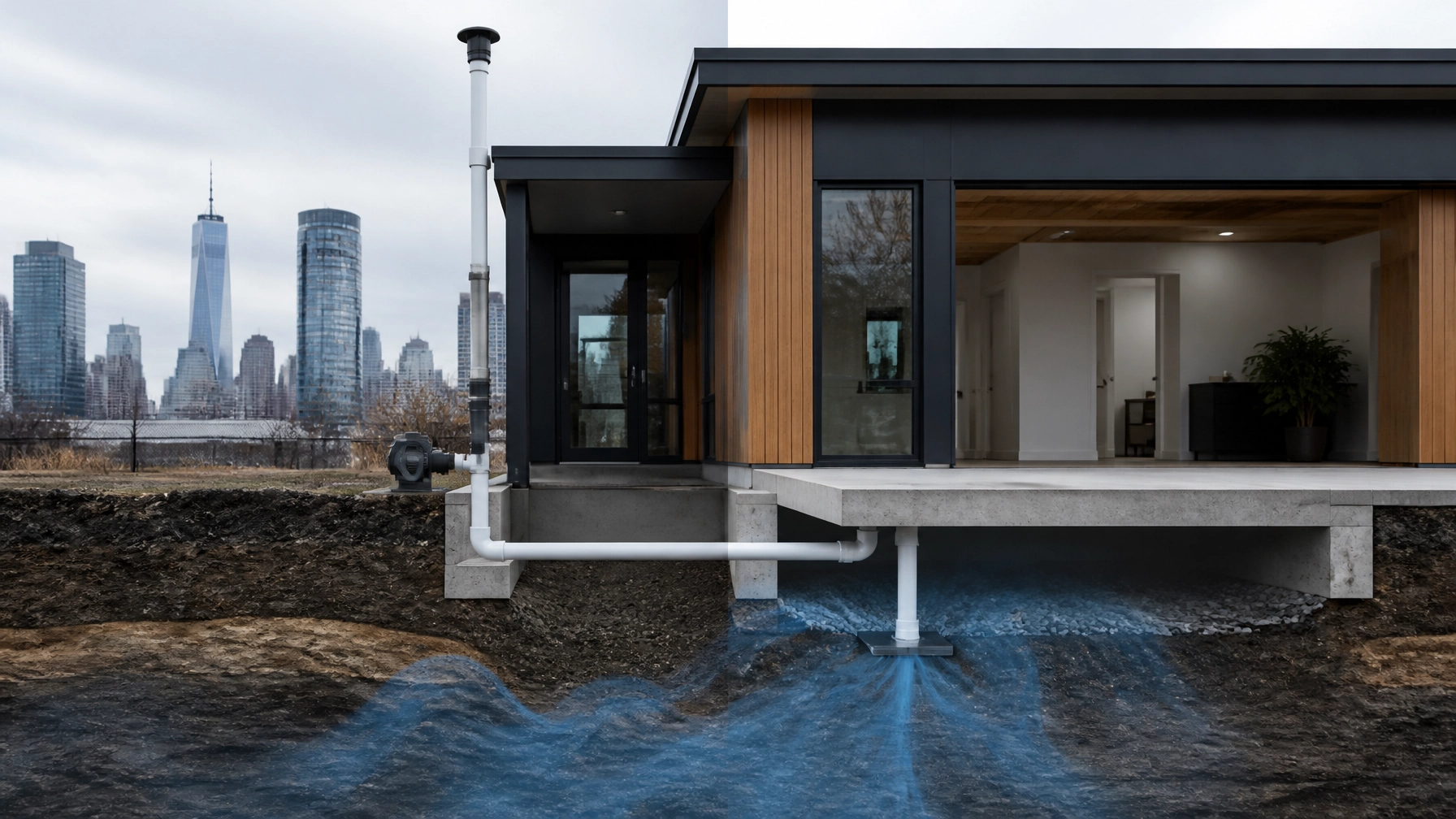
    When vapor intrusion is a confirmed risk, you have to mitigate. This usually involves a Sub-Slab Depressurization System (SSDS).

    The 2021 standards make the design of these systems even more critical. There is a common misconception that you can just "throw down a vapor barrier" and be done with it. Under the new rules, if your indoor air exceeds the standards, a passive barrier alone is rarely enough.

    Active sub-slab depressurization system (SSDS) installation

    The Envicon Approach to Mitigation:

    1. Precision Design: We don't over-engineer. Many firms will spec an active system with high-horsepower fans when a well-designed passive system with a site-specific ARS would satisfy the LSRP and the NJDEP.
    2. Vapor Barriers as Insurance: We treat vapor barriers not just as a checkbox, but as a critical engineering control that must be documented with field-level QA/QC.
    3. Communication: We sit at the table with your architects and MEP engineers. If the SSDS piping interferes with your utility layout, we solve it in the field, not through three weeks of "coordination meetings."

    Alternative Remediation Standards (ARS): Your Secret Weapon

    The 2021 rule formally expanded the Alternative Remediation Standards (ARS) framework to include the vapor intrusion pathway. This is a game-changer for high-value sites.

    Instead of being bound by the "default" NJDEP numbers, an ARS allows us to calculate a site-specific standard based on your building's actual characteristics: like air exchange rates, foundation thickness, and specific soil conditions.

    Why use an ARS?

    • It can eliminate the need for expensive active mitigation systems.
    • It can move a project from "remediation required" to "compliance achieved."
    • It provides a technically defensible path to a Response Action Outcome (RAO).

    Most consultants are too scared to propose an ARS because it requires more work and a deeper understanding of the toxicology. At Envicon, we see an ARS as a tool to unlock your site’s potential. We don't sell reports; we sell the cleared path to your RAO.

    Environmental lab sample vial for soil gas sampling

    The Envicon Difference

    When you're dealing with vapor intrusion in NJ, you aren't just fighting chemistry; you're fighting the clock. Every week your project sits in a "coordination queue" at a national firm is a week of carrying costs you’ll never get back.

    • LSRP Access: You talk to the person signing your documents. No middle managers.
    • Field-First Mentality: We know how NJ soil and groundwater behave because we’re on the sites daily, from Hudson County to the Shore.
    • Zero Jargon: We’ll tell you exactly what the 2021 standards mean for your bottom line, without hiding behind a 500-page report.

    Summary Checklist for Developers:

    • Re-evaluate old data: Does your 2019 Phase II meet the 2021 codified standards?
    • Check compound specifics: Are you dealing with 1,1-DCE or other updated VOCs?
    • Audit your footprint: If you're building over 50,000 sq. ft., is your sampling plan updated for the new density requirements?
    • Consult an LSRP early: Mitigation is 10x cheaper to install during construction than it is to retrofit.

    Don't let vapor intrusion stall your project. Contact Envicon Group today to review your site data and ensure you're compliant with the latest NJDEP standards.


    Envicon Strategic Solutions logo - MAIN

  • Dirt is Money: Navigating NYC Clean Soil Bank Eligibility

    Dirt is Money: Navigating NYC Clean Soil Bank Eligibility

    In New York City, dirt is rarely just dirt. Depending on how you manage it, it’s either a six-figure liability or a strategic asset.

    If you are a developer excavating a site in the five boroughs, you already know the pain of the "dirt tax." Between testing, hauling, and astronomical tipping fees at regional landfills, soil management can easily become one of the top five line items in your budget. But there is a technical loophole that most big-box consulting firms overlook because it requires more effort than simply checking a box: the NYC Clean Soil Bank (CSB).

    Managed by the NYC Office of Environmental Remediation (OER), the Clean Soil Bank is a soil recycling exchange. It allows "generating sites" to off-load excess clean soil at zero tipping fees and "receiving sites" to import it for free. You only pay for the trucking.

    At Envicon, we don’t just write reports telling you your soil is clean; we build the technical bridge to get that soil into the CSB, saving our clients hundreds of thousands of dollars in disposal costs. Here is the technical breakdown of how to navigate eligibility and turn your excavation into a profit center.

    The Financial Reality: Why "Clean" Costs So Much

    Most developers are shocked to find that even if their soil is "clean" by environmental standards, it still costs $50 to $100 per ton to dispose of at a traditional facility. Why? Because landfills charge for space, regardless of quality.

    The NYC Clean Soil Bank flips this. By matching your site with a city project or another private development that needs fill, the tipping fee is eliminated. For a typical mid-sized excavation of 5,000 cubic yards, the math is simple:

    • Traditional Disposal: $60/ton x 7,500 tons = $450,000
    • Clean Soil Bank: $0/ton tipping fee + Trucking = Significant Savings

    Are You Eligible? The Technical Thresholds

    Not every pile of dirt qualifies. To get a Beneficial Use Determination (BUD) from the OER, your soil must meet specific regulatory and physical criteria.

    1. Native Soil Only (No Anthropogenic Fill)

    The CSB is primarily interested in native, virgin soil: the glacial sands and silts that sit beneath the historic fill layer. If your site is covered in "black mayonnaise" or urban fill containing brick, ash, or glass, it’s a non-starter for the bank. We look for the transition point where the historic fill ends and the native material begins.

    2. Meeting the Part 375 Standards

    Your soil must be tested and proven to meet the lower of:

    • 6 NYCRR Part 375-6.8(b) Residential Standards
    • Protection of Groundwater Standards

    This requires a rigorous soil characterization plan. We see many developers get burned here because their consultant didn't take enough samples or failed to analyze for the specific parameters the OER requires. If your data is incomplete, the OER will reject the application, and you'll be stuck paying landfill rates while your trucks sit idle.

    Aerial view of an active NYC remediation site with soil staging areas and heavy equipment performing excavation of native material.

    The "Generating Site" vs. "Receiving Site" Dynamic

    The Clean Soil Bank operates as a matchmaker.

    • Generating Sites: These are typically deep excavations for foundations or utilities. To qualify, you must submit a Soil Availability Form to the OER along with your waste characterization data, boring logs, and a site map.
    • Receiving Sites: These are projects that need clean fill for grading, capping, or backfill. This includes NYC Parks projects, school gardens, and even private developments in the NYC Voluntary Cleanup Program (VCP).

    The key is timing. The OER doesn't store your soil indefinitely; they match "just-in-time" deliveries. This is where your consultant’s relationship with the agency matters. At Envicon, we sit at the table with the OER regularly. We know which city projects are looking for soil and how to align your excavation schedule with their intake needs.

    Why Your Current Consultant is Costing You Money

    If you’re working with a large national firm, they likely have a "standard operating procedure" for soil. That SOP usually involves calling a broker, getting a price for the nearest landfill, and putting it in a report. It’s the path of least resistance for them, but the most expensive for you.

    Big firms are defensive. They write reports to protect themselves from liability, not to optimize your bottom line. They often lack the local "boots on the ground" agility to coordinate the sampling, OER submittals, and logistics required for a successful CSB transfer.

    The Envicon Difference:

    1. Field-First Mentality: We identify native soil layers during the initial boring phase, not after the excavator is already digging.
    2. Regulatory Fluency: We know the OER reviewers by name. We don't guess what they want; we provide the exact data sets they need for a quick BUD approval.
    3. Proactive Management: We use our digital solution dashboards to track soil volumes and quality in real-time, ensuring that every yard of qualifying soil is diverted from the landfill.

    High-resolution technical inline image of a clean soil staging and characterization area in NYC with sample containers, organized stockpiles, heavy machinery, and a field laptop displaying GIS-based soil movement planning on a clean, compliant site.

    Step-by-Step: How to Qualify for the Clean Soil Bank

    1. Early Characterization: Do not wait until you have a pile of dirt. Conduct your Phase II Site Investigation with the CSB in mind. Sample deep into the native layers.
    2. Delineate the "Clean" Zone: Have your engineer create a clear 3D model or site plan showing exactly where the clean native soil begins. This prevents cross-contamination during excavation.
    3. Submit the Soil Availability Form: Work with a firm that understands OER's specific electronic submittal process. Precision here prevents delays.
    4. Logistics Coordination: Once approved, your soil needs a destination. This requires coordination between your site superintendent, the trucking company, and the receiving site.

    The "Dirt is Money" Takeaway

    In a city where every square foot is a battle, the NYC Clean Soil Bank is one of the few true "win-win" scenarios. It supports the city's sustainability goals while putting hundreds of thousands of dollars back into your project's contingency fund.

    However, the CSB is not a "set it and forget it" program. It requires technical precision, aggressive regulatory follow-up, and a consultant who views your budget as their own. If your current firm hasn't mentioned the Clean Soil Bank for your NYC excavation, you are likely leaving six figures in the ground.

    At Envicon, we remove the obstacles between you and a buildable site. Whether it’s navigating NYC OER E-Designations or optimizing your soil management plan, we provide the cleared path you need to move dirt: and your project: forward.

    Ready to see if your site qualifies?

    Don’t pay another tipping fee until you’ve had a professional review of your soil data. Contact the Envicon team today to turn your excavation liability into a clean asset.


    Summary of Benefits:

    • Zero Tipping Fees: Eliminate the largest cost of soil disposal.
    • Regulatory Compliance: Full OER oversight ensures you are protected from future liability.
    • Sustainability Credits: Qualify for "Green" points by recycling soil locally.
    • Shorter Hauls: Many CSB matches are within the five boroughs, reducing trucking time and fuel costs.

    Envicon Strategic Solutions logo - MAIN

  • Why a 72-Hour Phase I is the New Standard

    Why a 72-Hour Phase I is the New Standard

    In the high-stakes world of New York and New Jersey real estate, momentum is everything. You’ve spent months sourcing a deal, negotiating terms, and lining up financing. Then, you hit the "Environmental Wall." You call a national consulting firm, and they tell you they need three to four weeks to deliver a Phase I Environmental Site Assessment (ESA).

    In 2026, a three-week timeline isn’t just slow: it’s a liability.

    In a market where bridge loans have ticking clocks and sellers are fielding backup offers, the environmental consultant should be the one clearing the path, not the one standing in it. At Envicon Group, we’ve shifted the goalposts. The 72-hour Phase I isn't a "rush" service for us; it is the new standard of excellence.

    Here is why the old-school timeline is dead and how a tech-powered approach is keeping the most aggressive developers in NYC and NJ on schedule.

    The Death of the Three-Week Timeline

    If you’ve worked with a "big box" national firm, you know the drill. You talk to a senior partner during the pitch. They sound great. They have thousands of employees and offices in every state. But the moment you sign the proposal, your project is handed off to a junior associate: often someone sitting in a satellite office who hasn't stepped foot in the five boroughs in a year.

    That junior associate then spends the next week navigating their own internal bureaucracy. The report goes through three levels of "corporate QA/QC" that add zero value to your deal but add ten days to your calendar. They wait for database results to arrive by mail. They treat an ASTM E1527-21 compliant report like a creative writing project instead of a technical clearance document.

    At Envicon, we see it differently. We don’t sell 300-page reports filled with fluff to justify a high fee. We sell cleared paths to closing. When you’re paying carry costs on a multi-million dollar property, every day that Phase I sits in someone’s queue is money out of your pocket.

    How We Do It: The 72-Hour Engine

    People often ask us, "How can you produce a bulletproof, lender-ready report in 72 hours when the big guys take a month?" The answer isn't that we work harder (though we do); it’s that we’ve rebuilt the engine from the ground up.

    1. Proprietary GIS and Data Integration

    Traditional firms wait for third-party vendors to deliver historical data. We’ve built our own internal infrastructure that integrates with NYC OpenData, NJDEP GeoWeb, and proprietary historical archives.

    A technical, professional visualization of 3D GIS environmental data for a NYC city block

    While the other guy is still waiting for a PDF of a 1950s Sanborn map to arrive in his inbox, our team has already mapped the historical fill, identified the location of a 1970s-era underground storage tank (UST), and flagged the neighboring dry cleaner as a potential vapor intrusion risk. This real-time data access allows us to start the technical analysis the moment the project is authorized.

    2. The "Field-First" Mentality

    We don't wait for the "official" start date. Our engineers are on-site within 48 hours: often sooner. Because we are local to the NY/NJ metro area, we don't have to wait for a regional manager to approve travel or for a field tech to drive in from two states away. We are in the dirt, on the roof, and in the basement while the national firms are still setting up their internal project codes.

    3. Senior-Led Execution

    One of the biggest time-wasters in environmental consulting is the "review loop." A junior staffer writes a draft, a project manager marks it up, and a senior engineer finally looks at it two weeks later only to realize they missed a Recognized Environmental Condition (REC).

    At Envicon, the senior engineer is the lead. By putting experienced PEs (Professional Engineers) at the front of the process, we eliminate the errors that cause delays. We know what lenders are looking for, and we know what regulators at the NYC OER or NJ DEP require. We get it right the first time, which means no back-and-forth and no rejected reports.

    Records, Regulations, and Relationships

    The most common objection to a 72-hour turnaround is the record-search. Critics will say, "You can't get a response from an NJDEP OPRA request or a NYC FOIL request in three days."

    They’re right: if you’re just sitting around waiting for a government clerk to mail you a thumb drive.

    But an expert insider knows that a Phase I is about more than just a records dump. It’s about professional judgment. We leverage 20 years of direct agency relationships. We know which databases are updated in real-time and which local fire departments have digitised their tank records.

    When a formal record request is lagging, we don't just put "Data Gap" in the report and call it a day. We find the person who knows the answer. We talk to the architects, the local officials, and the previous owners. Collaboration isn't a buzzword for us; it’s the tactical maneuver we use to bridge the gap between "pending" and "closed."

    A high-end tablet displaying a real-time project dashboard next to a thick Phase I ESA report

    Precision Over Speed: Why Lenders Love It

    There is a dangerous misconception that "fast" means "sloppy." In the world of environmental due diligence, sloppiness is the fastest way to kill a deal. If a lender flags a report for missing an ASTM-required interview or failing to document a floor drain, your 72-hour turnaround becomes a 2-week nightmare of revisions.

    We maintain a 100% lender approval rate. Why? Because our reports are built defensively. We write them to protect the client, but we structure them to satisfy the most conservative bank reviewers.

    "If your Phase I ESA isn't accepted by your lender, we'll revise it at no charge." : This isn't just a marketing line; it’s a standard we’ve lived by for two decades.

    Every 72-hour report undergoes the same rigorous technical scrutiny as our standard-timeline projects. The difference is the technology and the seniority of the people doing the work. We aren't cutting corners; we're cutting out the waste.

    The Financial Reality of Environmental Delays

    Let’s talk numbers. Suppose you’re looking at a $10M acquisition in Long Island City. Your carrying costs could easily be $1,500 to $3,000 per day.

    • The National Firm Path: 21 days for a report. Total carry cost: $42,000+.
    • The Envicon Path: 3 days for a report. Total carry cost: $6,000.

    By choosing a partner who values your timeline, you’ve just saved $36,000 before the first shovel hits the ground. That is the "Envicon Edge." We understand that environmental consulting is a business tool, not just a regulatory hurdle. Our job is to de-risk your investment so you can deploy capital with confidence.

    An environmental professional in a high-visibility vest on an urban site using a tablet

    Summary: A Clear Path Forward

    In today’s market, you can't afford a consultant who thinks like a librarian. You need a partner who thinks like a developer. The 72-hour Phase I is the new standard because the modern real estate market demands it.

    • Tech-Driven: Using GIS and real-time data to bypass manual research.
    • Senior-Led: Direct access to PEs who know the NYC/NJ regulatory landscape.
    • Result-Oriented: Focused on clearing paths to closing, not just writing reports.
    • Lender-Approved: Bulletproof documentation that passes review the first time.

    Don't let a "big box" firm's bureaucracy stall your project. Whether you're dealing with a complex brownfield redevelopment in Newark or a time-sensitive warehouse acquisition in Brooklyn, we take ownership of the outcome.

    Your deal won't wait. Neither will we.

    Take the Next Step

    Is your Phase I sitting in someone’s queue? Stop waiting and start moving.

    Contact Envicon Group today for a same-day proposal, or use our Instant Environmental Risk Screener to assess your property’s red flags in seconds. Let's get your project to the finish line.

  • Stormwater Management (SWPPP) Secrets

    Stormwater Management (SWPPP) Secrets

    It’s 7:00 AM on a Tuesday. You’re at the job site in Hudson County, the coffee is still hot, and an NJDEP inspector is walking toward your trailer. He’s not here for a social call. He wants to see your Stormwater Pollution Prevention Plan (SWPPP) and, more importantly, he wants to see how it’s being executed in the field.

    For most developers, a SWPPP is a 200-page binder that sits on a shelf until someone asks for it. But in 2026, with the NJPACT (New Jersey Protecting Against Climate Threats) and REAL (Resilient Environments and Landscapes) rules now in full effect, that "check-the-box" mentality is a fast track to five-figure fines and stop-work orders.

    At Envicon Group, we don’t treat stormwater as a permit hurdle. We treat it as a civil engineering opportunity. If you’re looking for SWPPP services in NJ, you need to know the "secrets" that separate a stalled project from a buildable asset.

    The 2026 Reality: Why Your Old SWPPP Is Obsolete

    As of January 20, 2026, the NJDEP fundamentally changed the game. The updated N.J.A.C. 7:8 standards and the new 2026 NJ Stormwater BMP Manual aren't suggestions: they are the law of the land for any major development.

    If your consultant is still using 2023 templates, you’re already behind. The new framework mandates:

    • Mandatory Green Infrastructure (GI): You can no longer just pipe water into a giant hole in the ground. You must use bioretention, pervious paving, or green roofs to meet recharge and quality standards.
    • Climate-Adjusted Rainfall Data: We’re designing for the storms of 2050, not 1990. This means larger basins, smarter routing, and zero margin for error in your hydrologic modeling.
    • 95% TSS Removal for C1 Waters: If your site discharges to Category One waters, the bar for Total Suspended Solids (TSS) removal has been raised. Standard "off-the-shelf" solutions won't cut it anymore.

    Secret #1: Smart Civil Design Is the Ultimate Cost-Saver

    Most "big box" firms look at stormwater as an isolated environmental requirement. They design a site plan, then hand it to a junior environmental staffer to "add the SWPPP."

    That’s backwards.

    At Envicon, our civil and environmental teams sit at the same table. We integrate Green Infrastructure BMPs into the site’s early grading and utility plans. Why? Because a bioretention basin that doubles as a landscaped amenity saves you square footage. A pervious paving system that handles parking and groundwater recharge simultaneously reduces your infrastructure spend.

    By designing for operational compliance from day one, we prevent the "not my problem" finger-pointing between consultants that typically leads to expensive change orders during construction.

    Close-up of a Green Infrastructure bioretention system integrated into a professional landscape, showing how smart design meets NJDEP standards.

    Secret #2: The "Defensive Report" vs. The Actionable Plan

    When you hire a massive national firm, they give you a bloated report written to protect their liability, not your timeline. It’s full of "if/then" statements and vague requirements that leave your contractor guessing.

    Envicon produces clean, field-ready documentation. Our SWPPPs include:

    1. Clear Erosion & Sediment Control (ESC) Plans: No jargon. Just clear instructions on where the silt fence goes, how the stabilized entrance must be maintained, and exactly when to call for an inspection.
    2. LSRP-Aligned Strategies: In New Jersey, your stormwater often intersects with contaminated soil. We are one of the few firms with LSRP services on staff to ensure your SWPPP doesn't accidentally trigger a multi-million dollar remediation issue by infiltrating water through "hot" zones.
    3. Audit-Ready Logs: When that 7 AM inspector arrives, our clients hand over a tablet with real-time, timestamped inspection logs. It turns a potential confrontation into a 15-minute verification.

    Secret #3: Agency Relationships Move the Needle

    Regulatory coordination shouldn't be a black box. If your consultant doesn't know the reviewer at the NJDEP or the local Soil Conservation District by name, you’re just another file in the queue.

    For 20 years, we’ve sat across the table from NJDEP, NYC OER, and NYC Parks. We understand their specific pain points: like the current push for small-scale GI over centralized basins. We design to meet their unwritten expectations, which is why our permits are often accepted on the first submission.

    "Envicon designed our stormwater management system under a 3-week deadline that two other firms refused. Their NJDEP permit application was accepted without revision."
    : Amanda Foster, Project Director, Garden State Developers

    Aerial site map overlaid with utility infrastructure and stormwater management planning, representing technical precision in civil engineering.

    The Hidden Danger: The "Wait and See" Mistake

    The biggest mistake developers make is waiting until the tail end of the design phase to worry about the SWPPP. With the REAL rules now affecting coastal redevelopment and parking lot reconstructions, your stormwater strategy can dictate your entire site layout.

    If you reconstruct more than an acre of parking in NJ today, you aren't just repaving; you're triggering full stormwater treatment requirements. If you haven't budgeted for the GI BMPs needed to treat that runoff, your pro forma is already broken.

    Envicon’s Tech-Powered Advantage

    We’ve replaced spreadsheet chaos with real-time environmental dashboards. Our clients get:

    • Live Inspection Tracking: See exactly when our field team completes an ESC inspection.
    • Automated Alerts: Get notified if a rain event triggers a mandatory 24-hour inspection.
    • Data-Driven Visuals: Professional maps and pollutant removal calculations that satisfy both lenders and regulators.

    This level of transparency changes the dynamic of a project. Decisions are made faster, and you’re never in the dark about your compliance status.

    Modern dashboard interface showing real-time field monitoring and compliance data, highlighting Envicon's technology-driven approach.

    Summary: A Clear Path to a Buildable Site

    Stormwater management in New Jersey is no longer a peripheral concern: it is a core engineering challenge. To avoid NJDEP fines and keep your project moving, you need a partner who understands:

    • The 2026 NJPACT/REAL standards and how to design for them.
    • Integrated Civil & Environmental engineering to maximize land use.
    • Proactive communication with agency reviewers to accelerate permits.

    At Envicon, we don't just sell reports. We sell cleared paths. We take full responsibility for the outcomes: whether it's securing a permit under a tight deadline or managing complex field challenges.

    Your project is too valuable to sit in a queue.

    Contact Envicon Group today for a site-specific SWPPP audit or to discuss how our integrated civil-environmental team can de-risk your next NJ development.


    Takeaway Checklist for NJ Developers in 2026:

    • Verify Major Development Status: Does your site exceed 1 acre of disturbance or 0.25 acres of new impervious surface?
    • Review GI Requirements: Are you using the Chapter 9/10 BMPs from the 2026 Manual?
    • Check C1 Discharge: Are you meeting the 95% TSS removal threshold?
    • Audit Your Consultant: Is your current firm providing real-time data or just "CYA" reports?

  • The Triad Approach: How Smarter Site Characterization Saves NYC Projects Months

    The Triad Approach: How Smarter Site Characterization Saves NYC Projects Months

    In the New York City development world, the "mobilization loop" is a silent project killer. You hire a consultant, they drill a dozen holes, send samples to a lab, and then everyone waits three weeks for a report. The report comes back with a "data gap": one of those vague phrases that means your consultant didn't find the edge of the plume and now they need to go back out.

    That’s another mobilization, another two weeks of field time, and another month added to your schedule while your carry costs tick up. If you're working within the NYC OER Voluntary Cleanup Program (VCP) or chasing a NYSDEC Brownfield Tax Credit, these delays aren't just annoying; they are financially catastrophic.

    At Envicon, we don't play the "wait-and-see" game. We use the Triad Approach.

    Triad is a high-resolution, data-driven framework designed to condense months of traditional site investigation into weeks of surgical, field-based execution. It’s how we move projects from "contaminated" to "cleared" without the endless cycle of remobilizations.

    What is the Triad Approach?

    The Triad Approach isn't a new regulation; it’s a decision-making framework championed by the EPA and increasingly recognized by NYSDEC for complex sites. It rests on three pillars: Systematic Project Planning, Dynamic Work Strategies, and Real-Time Measurement Technologies.

    When applied to a NYC project, Triad replaces the static, "cookie-cutter" work plan with a living strategy that evolves as we pull dirt.

    1. Systematic Project Planning: The Power of the CSM

    Most firms treat the Conceptual Site Model (CSM) as a box to check in a final report. We treat it as the foundation of the entire project. Before a single rig hits the site, we sit at the table with you, your architects, and the regulators (OER or NYSDEC) to define exactly what decisions need to be made.

    Are we looking for the edge of a CVOC plume to protect a neighboring foundation? Are we trying to delineate historic fill to optimize disposal costs? By defining the "uncertainty" upfront, we ensure the field team knows exactly what a "win" looks like before they start.

    2. Dynamic Work Strategies (DWS)

    This is where the "Big Box" firms fall apart. In a traditional workflow, the field tech has a map with 10 dots. They drill those 10 dots and leave. If the 10th dot shows massive contamination, they don't have the authority or the expertise to move 10 feet over and drill an 11th hole. They just go home and wait for the lab.

    With a Dynamic Work Strategy, we give our field leaders the technical authority to adjust in real-time. If we see a visual or PID hit that wasn't expected, we chase it right then and there. We don't ask for permission to be smart; we build the flexibility into the work plan so the regulator has already signed off on our ability to adapt.

    3. Real-Time Measurement (HRSC)

    You can't make real-time decisions with three-week lab turnarounds. We utilize High-Resolution Site Characterization (HRSC) tools like Membrane Interface Probes (MIP), Laser-Induced Fluorescence (LIF), and onsite mobile labs. These tools give us a continuous data stream of what’s happening sub-surface.

    Instead of guessing where the "hot spot" is based on five soil samples, we have a 3D digital map of the contaminant plume while the rig is still on site.

    Close-up field tablet displaying live contaminant plume mapping, PID readings, and borehole locations beside sampling equipment and drill rig components on an active urban investigation site.

    Why Traditional Sampling Fails NYC Developers

    The standard "Phase II" approach: sampling on a grid and waiting for results: is a relic of a slower era. In the NYC market, where a "Notice to Proceed" from OER is the gatekeeper to your foundation permit, you cannot afford to be wrong.

    1. The "Blind Spot" Risk: Traditional sampling is sparse. If you miss a pocket of chlorinated solvents or a buried tank because it wasn't under one of your "grid dots," you won't find out until the excavator hits it during bulk dig. Now your project is halted, the FDNY is involved, and your disposal costs just tripled.
    2. The Regulatory Queue: Every time you submit a supplemental investigation report to a reviewer at NYSDEC or OER, you go back to the bottom of the pile. Triad ensures that when we submit an Investigation Report, it is complete, delineated, and ready for a Remedial Action Plan (RAP).
    3. Disposal Surprises: Soil management is often the largest line item in a remediation budget. Without high-resolution data, consultants over-excavate "just in case." We use real-time data to draw surgical lines between clean and contaminated soil, saving hundreds of thousands in soil disposal fees.

    Triad in Action: Navigating the NYC OER and NYSDEC Landscape

    New York regulators don't just want data; they want defensible data. The common misconception is that Triad and HRSC are "shortcuts." In reality, they provide more data than the traditional method: just faster.

    The NYC Voluntary Cleanup Program (VCP)

    For sites with an E-Designation, the goal is a Notice of Satisfaction. By using a Triad approach, we can often combine the Remedial Investigation (RI) and the delineation phase into a single mobilization. This can shave 2–4 months off the pre-construction timeline, allowing you to get your foundation piles in the ground while your competitors are still waiting for their second round of lab results.

    NYSDEC Brownfield Cleanup Program (BCP)

    On BCP sites, the "Certificate of Completion" (COC) is the golden ticket for tax credits. The DEC is notoriously rigorous about plume delineation. Using HRSC tools allows us to demonstrate to the DEC reviewer that we have truly "found the bottom." It eliminates the back-and-forth "comment letters" that plague projects when a consultant provides a data set full of holes.

    The Envicon Difference: Field-First Leadership

    Large national firms hire junior staff to sit on a bucket and watch a drill rig. Those staff members don't understand the Triad Approach because they aren't empowered to make decisions. They are data collectors, not problem solvers.

    At Envicon, we are PE-led and field-first. When we deploy a Triad strategy, you have a senior-level expert who knows the NYC regulatory landscape standing next to the rig. We don't just deliver a report that says "more work is needed." We deliver a cleared path.

    We’ve integrated this philosophy into our digital solutions, providing real-time dashboards where you can see the characterization data as it’s being generated. You aren't waiting for a monthly PDF update; you're seeing your project move forward in hours, not weeks.

    Summary: The High-Resolution Advantage

    The Triad Approach is the most effective way to manage the environmental risks that stall NYC developments. By front-loading the intelligence and empowering the field team, we eliminate the "mobilization loop" and get you to a buildable site faster.

    Key Takeaways:

    • Stop the Remobilization Cycle: One surgical mobilization is cheaper and faster than three "fishing expeditions."
    • Real-Time Data = Real-Time Decisions: HRSC tools give us the "truth" while the equipment is still on-site.
    • Regulatory Confidence: Proving you have delineated the site with high-density data leads to faster approvals from OER and NYSDEC.
    • Surgical Remediation: Use precise mapping to minimize soil disposal costs and target only what needs to be cleaned.

    If your project is currently "stalled" in the investigation phase, or if you’re looking at a complex NYC site and need a clear path to closure, let’s talk. We don't sell reports; we sell cleared paths.

    Ready to move your project forward? Contact the Envicon team today to discuss a Triad-based approach for your next site.

    Envicon Strategic Solutions logo - MAIN